The 1921 expedition served as a reconnaissance of Everest and laid the groundwork for the 1922 expedition, the first with the explicit goal of summiting the mountain. The 1922 expedition did not make the summit but set a new world record climbing height of 8,321 metres but was met with disaster when seven porters died as a result of an avalanche.
At a Glance
344
Total Deaths
undetermined
Total Injuries
37,828 days
Duration
June 1922 - Dec. 2025
Date(s)
Dangerous Places
Type of Event
Mount Everest, Himalayan Mountains, Nepalese-Chinese Border
Location
Facts
Located on the border of Nepal and China (Tibet), Mount Everest is the highest point on Earth, rising 8,848.86 meters (29,031 feet, 8.5 inches) above sea level according to the most recent estimate. Also known as “Chomolungma/Qomolangma” (“holy mother”) in Tibetan, “Sagarmāthā” or “Sagar-Matha” (“goddess of the sky”) in Nepali/Sanskrit, and “Zhūmùlǎngmǎ Fēng” (珠穆朗玛峰) in pinyin Chinese, Everest is also one of the most difficult mountains in the world to climb.
Much of the difficulty comes from the extreme harshness of the environment. At Everest’s peak, the average daytime high ranges from -2 degrees F (-19C) in summer to -33F (-36C) in winter. At any temperature, the air contains only 1/3 as much oxygen as the air at sea level. Moreover, Everest is so tall that its summit reaches the atmospheric jet stream, resulting in winds that regularly reach 160 km/h (100 mph) or more.
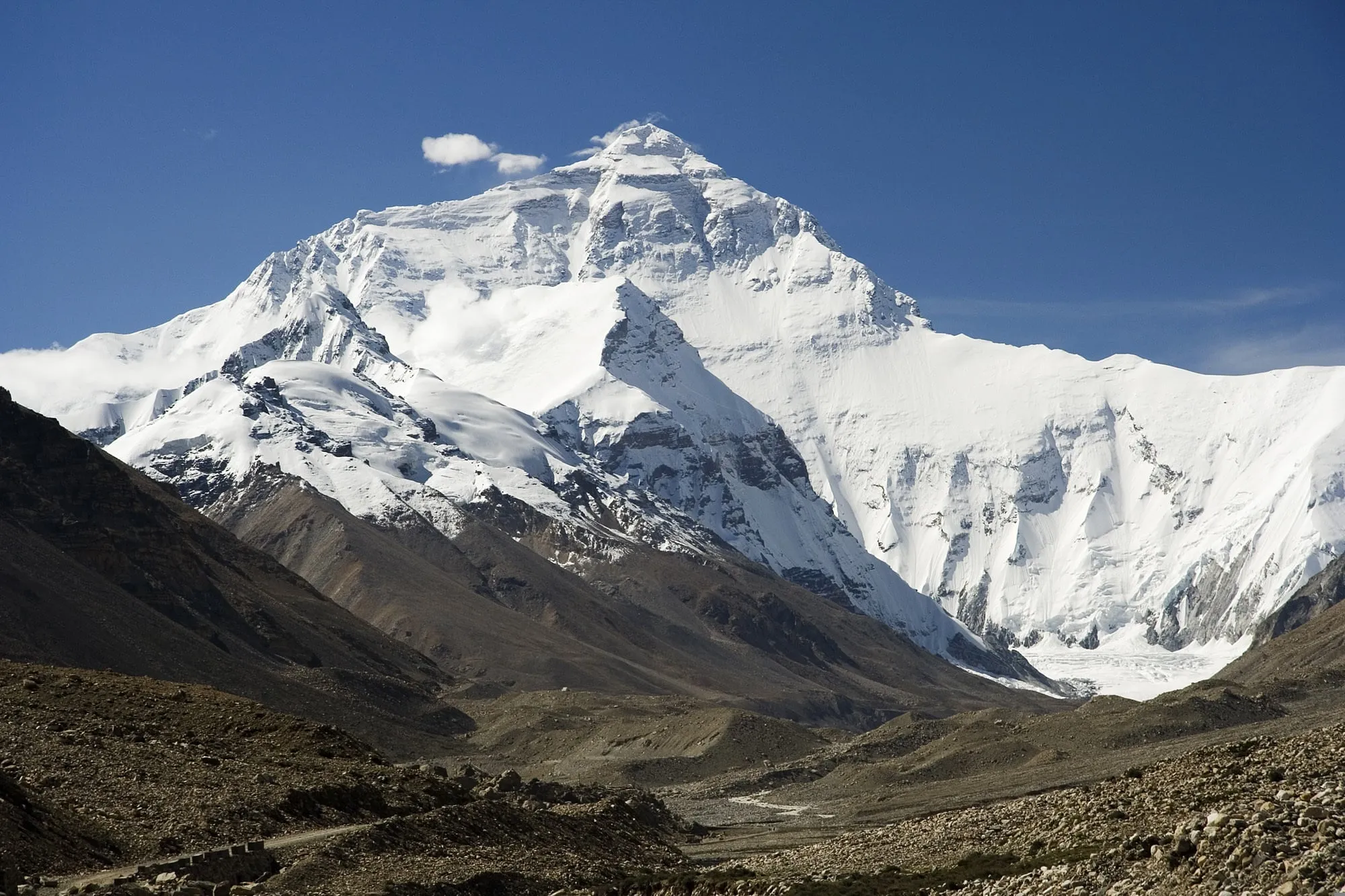
Mount Everest on February 16, 2016.
Deaths as % of Attempts (through 2025):
- 32,154 Attempted Climbs
- 7,488 Successful Climbers
- 23.29% Successful Climbers
- 344 Deaths
- 1.07% Death Rate
- Modern Equivalent to 1.07% Deaths (2025 pop.): 82,316,131
Ascending vs Descending Fatalities:
- 246 (71.51%) Died Without Reaching Summit
- 98 (28.49%) Died After Reaching Summit
Bodies Still on the Mountain:
- 200+ (exact total unknown as some may not have been discovered)
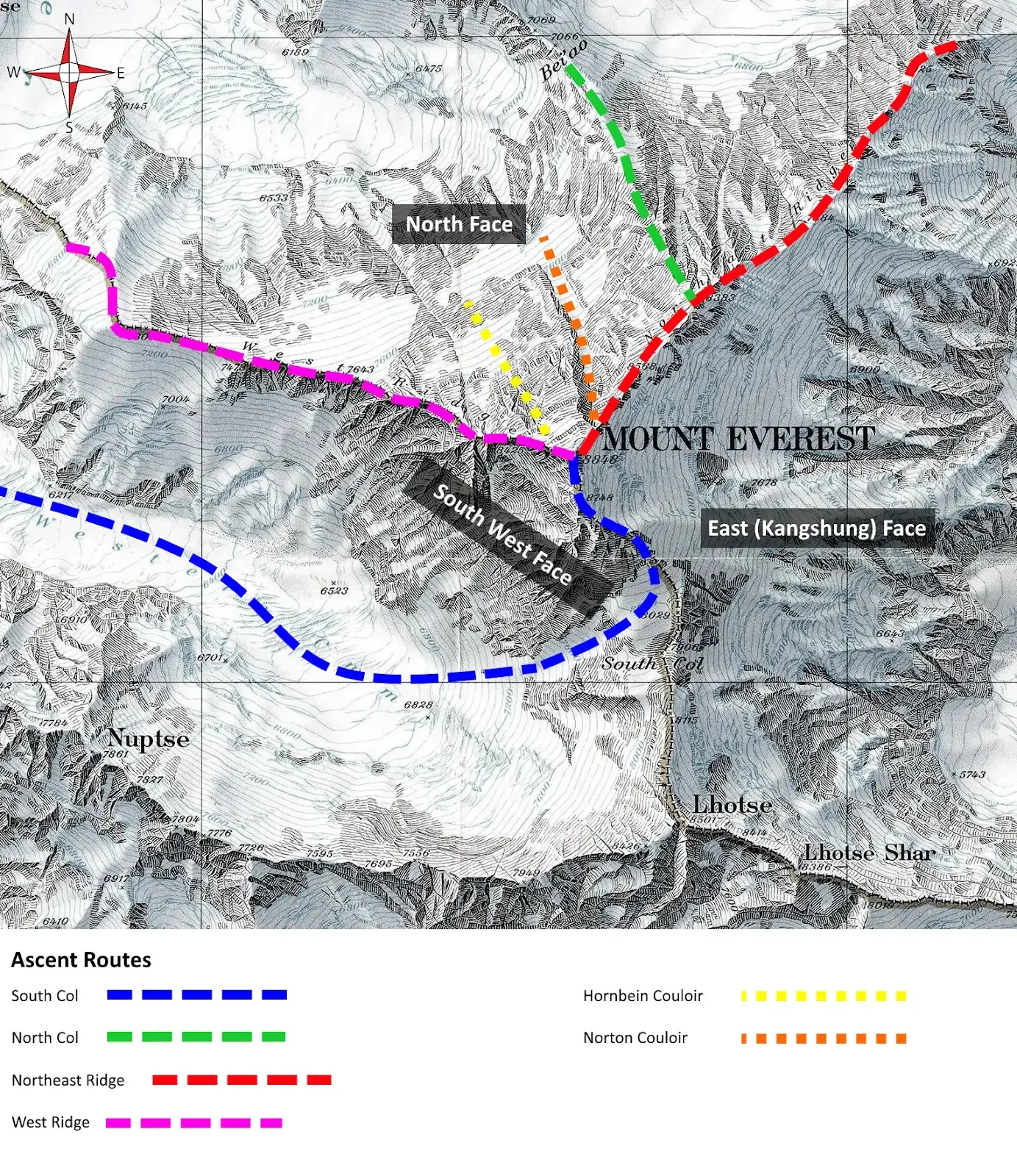
Map of Everest climbing routes.
Expeditions, Ascents and Deaths by Route:
A “failure” is an expedition in which no climber reached the summit. A “summit” is an individual climber who reached the summit.
- East (Kangshung) Face - 6 failures, 13 summits, 0 deaths
- East Ridge - 3 failures, 4 summits, 0 deaths
- North Col - 326 failures, 3,938 summits, 92 deaths
- North Face - 54 failures, 33 summits, 10 deaths
- North Side - 4 failures, 0 summits, 0 deaths
- North East Ridge - 10 failures, 16 summits, 5 deaths
- Reconnaissance - 4 failures, 0 summits, 3 deaths
- South Col - 389 failures, 9,677 summits, 199 deaths
- South West Face - 24 failures, 42 summits, 14 deaths
- West Ridge - 36 failures, 31 summits, 21 deaths
Deaths by Altitude (m):
- 0000-4000m - 4 (1.16%)
- 4001-5335m - 10 (2.91%)
- 5336-6060m - 84 (24.42%)
- 6061-6505m - 25 (7.27%)
- 6506-7065m - 33 (9.59%)
- 7066-7900m - 50 (14.53%)
- 7901-8790m - 127 (36.92%)
- 8791-8848m - 11 (3.20%)
Deaths by Time of Year:
- Spring Season (Mid-April to Late May) - 13,427 Ascents, 266 Deaths (0.02 per Ascent)
- Summer Season (Monsoon June to Mid-Sept.) - 9 Ascents, 1 Death (0.11 per Ascent)
- Autumn Season (Late Sept. to Mid-Nov.) - 301 Ascents, 70 Deaths (0.23 per Ascent)
- Winter Season (Late Nov. to Early April) - 15 Ascents, 7 Deaths (0.47 per Ascent)
Causes of Expedition Failure:
- 15 (0.63%) - Did not climb
- 127 (5.32%) - Illness, Acute Mountain Sickness/AMS
- 53 (2.22%) - Accident
- 39 (1.63%) - Route Difficulty
- 85 (3.56%) - Bad Conditions
- 300 (12.57%) - Bad Weather
- 50 (2.10%) - Lack of Supplies
- 160 (6.71%) - Other
- 4 (0.17%) - Attempt Rumored
- 11 (0.46%) - Lack of Time
- 3 (0.13%) - Not to Reach Base Camp
Percentages shown are taken from the total of all 2386 expeditions both successful and unsuccessful. In all, 847 expeditions (35.5%) have failed. 1535 expeditions (64.33%) have been successful, and the remaining 4 (0.17%) have claimed success, but lacked documented proof.
Acute mountain sickness (AMS) is an intense form or altitude sickness that can ultimately render the victim disoriented and/or unconscious, both extremely dangerous conditions in Everest’s unforgiving environment. When normal treatment (medication, rest, supplemental oxygen, portable hyperbaric bags) cannot alleviate AMS symptoms, climbers often abort their attempt, resulting in an expedition failure.
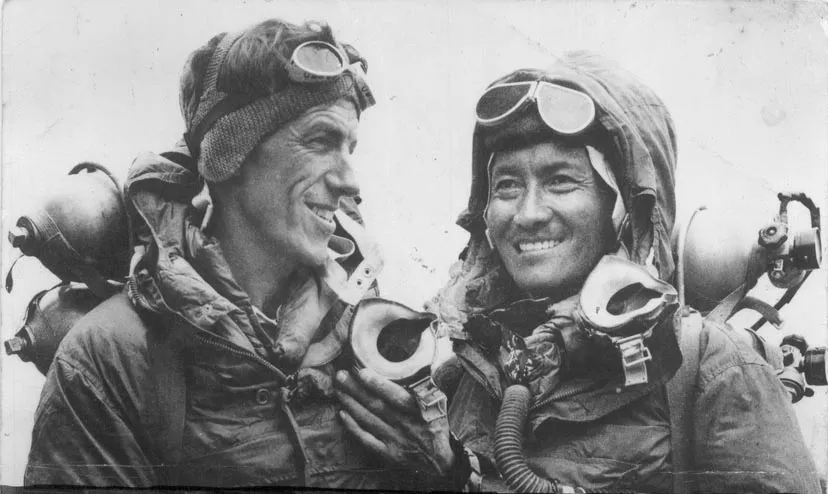
Edmund Hillary and Tenzing Norgay on May 29 1953, shortly after becoming the first men to successfully reach the summit of Mount Everest and return.
Deaths by Gender:
- Males: 12,704 ascents, 330 deaths (0.03 deaths per ascent)
- Females: 1,048 ascents, 14 deaths (0.01 deaths per ascent)
Deaths by Host Country:
- Nepal: 9,890 ascents, 232 deaths (0.16 per expedition)
- China: 3,862 ascents, 112 deaths (0.12 per expedition)
Deaths by Age:
- Unknown: 169 ascents, 42 deaths
- 13-17 - 50 ascents, 0 deaths,
- 18-24 - 1,486 ascents, 24 deaths
- 25-30 - 2,975 ascents, 62 deaths
- 31-35 - 2,791 ascents, 59 deaths
- 36-40 - 2,381 ascents, 46 deaths
- 41-45 - 1,798 ascents, 41 deaths
- 46-50 - 1,115 ascents, 25 deaths
- 51-55 - 590 ascents, 23 deaths
- 56-60 - 273 ascents, 7 deaths
- 60+ - 124 ascents, 15 deaths
Timeline
Total Deaths
Data regarding the number of deaths on Mount Everest before the 1920s is largely nonexistent. However, conditions on the mountain are so unforgiving that it is unlikely that many significant attempts to reach the mountain’s peak were made before this time.
Although death totals are generally lower in earlier years, this is not an indication that the climb has become more dangerous over time. Rather, it reflects the fact that far fewer individuals attempted the climb in earlier days. The overall death rate is significantly lower today than it was even 20 years ago.
7 deaths
1921 & 1922 Mount Everest Expeditions
0 deaths
First Summit of Everest
Tenzing Norgay and Sir Edmund Hillary made the first successful ascent of Mount Everest in 1953, 22 years after the first organized expedition to climb the mountain in 1921. They took a route through the Khumbu Icefall onto the South Col. While the final leg fo the ascent took two days, the process of climbing and establishing a series of progressively higher base camps had begun roughly six weeks earlier. 15 people had died during earlier attempts.
0 deaths
First Ascent without Supplemental Oxygen
Reinhold Messner and Peter Habeler made the first ascent of Everest without supplementary oxygen in 1978, making it through the treacherous "Death Zone" through acclimitisation and grit. Messner would go on to be the first person to climb all fourteen 'eight-thousanders', doing them with oxygen. 35 people had died on earlier attempts.
0 deaths
First Woman to Summit Everest
Junko Tabei became the first woman to summit Everest in 1975 Japanese Women's Everest Expedition. Her summit was made in spite of the expedition being caught in an avalanche and unforseen complications on the route.
0 deaths
First Winter Ascent
Completed by Leszek Roman Cichy and Krzysztof Wielicki. Previous attempts had resulted in one casualty.
8 deaths
1996 Everest Disaster
Disaster struck several expeditions on Everest simultaneously as a blizzard caught several teams on their way down from the summit. Eight died, mostly from exposure or suspected falls, raising questions about the commercialization and overcrowding of Everest mountaineering.
16 deaths
2014 Avalanche
The start of the 2014 climbing season saw 16 sherpas killed in an ice avalanche in the Khumbu Icefall while they were preparing routes through the glacier for expeditions in the coming season. As a result of this, the surviving sherpas announced that they would not work on Everest for the remainder of 2014 out of respect for those killed.
24 deaths
2015 Mount Everest Avalanches
Mount Everest was hit again by a number of large avalanches following a 7.8 magnitude earthquake that struck Nepal in the spring of 2015. Notably, Everest base camp was badly hit by an avalanche originating from neighboring Pumori, resulting in the deadliest single day in known history for climbers on Everest.
Additional noteworthy events in Mount Everest history:
- June 08, 1924 - Pioneering British mountaineers George Mallory and Andrew Irvine, set off on an attempt to reach Everest’s summit. Neither would return. Mountaineers continue to this day to debate whether the pair reached the top before succumbing to the mountain’s many dangers.
- 1933 & 1936 - Hugh Ruttledge leads unsuccessful attempts to climb Everest’s northern face, controlled at the time by the country of Tibet.
- May 1960 - Chinese climbers Wang Fuzhou, Gonpo, and Qu Yinhua reportedly become the first climbers to reach Everest’s peak from the North Ridge, now controlled by China.
- May 01, 1999 - The body of George Mallory, missing since 1924, is found on the mountain. The foot of his partner, Andrew Irvine, would be found in 2024.
- 2013 - Japanese climber Yuichiro Miura summits Everest at age 80, reclaming his title of the oldest climber to do so (he had also summitted the mountain at ages 70 & 75, but later lost the record to 76-year-old Nepalese climber Min Bahadur Sherchan). As of 2026, Miura’s record still stands.
Map
Mountaineers travel from all around the world to climb Mount Everest—and the mountain’s global popularity is reflected in the fact that the mountain has claimed the lives of climbers from dozens of countries.
Nepal tops the list of deaths by a large margin. This is understandable, as Nepal is not only the country from which the majority of Everest climbs launch, but also the home country of the majority of the mountain’s sherpas—climbing guides who lead expeditions of clients up and down the mountain. Although sherpas are nearly always skilled climbers and are much more familiar with Everest than the average climber, the fact that they attempt to ascend the mountain as their everyday profession puts them at greater risk than other nationalities, who attempt to climb the mountain only as a special occasion.
It is important to note that “sherpa” has two forms, each with its own meaning. When used in lower-case, “sherpa” refers to the professional climbing guides mentioned above. However, upper-case “Sherpa” is an ethnic group of people who populate the regions around Everest in Nepal. Most (but not all) sherpas are also Sherpas.
Death Totals by Country
Deaths
1
3
5
10
20
50
100
150
Categorization of Deaths (How)
Cause of Death
The risk of a fatal fall is just the first of a wide variety of potential causes of death for climbers of Everest and other mountains over 8,000 meters in height (referred to as “8,000-ers” by mountaineers). In addition to falls, which are a primary concern at higher elevations, deadly avalanches are a major risk during the lower parts of the climb.
In addition, the omnipresent cold and near-constant wind can kill several ways, including freezing, illness, sheer exhaustion, and acute mountain sickness (AMS)—a form of altitude sickness which can render the victim disoriented and confused, dizzy and vomiting, and ultimately unconscious. Finally, even the healthiest climbers can wander off-course in the frequent low-visibility conditions and get lost in the snow and fog, never to be seen alive again.
In fact, the harsh environment at Everest’s peak has created one of the mountain’s more morbid statistics: More than 200 corpses remain on the mountain, either because they’ve never been found or because retrieval attempts would be too dangerous, too costly, or both.
Categorization of Deaths (Who)
Who Died
Group | Deaths↓ |
|---|---|
| Climbers with Supplemental Oxygen | 13,518 |
| Climbers without Supplemental Oxygen | 234 |
Show more
Attempts to summit Everest became much more common once supplemental oxygen became available.
Approximately 95% of climbers who successfully summit Everest utilize some form of supplemental oxygen. The atmospheric pressure at Everest’s peak drops to 0.333 standard atmospheres, which results in the air containing only 1/3 as much oxygen as it would at sea level. If not properly acclimated, the average climber would lose consciousness within a few minutes under such low-oxygen conditions. Supplemental oxygen helps alleviate this risk.
With Supplemental Oxygen
When first used by British expeditioners George Finch and Geoffrey Bruce in 1922, bottled oxygen was considered an "unsportsmanlike" option. However, it also enabled climbers to finally reach Everest's peak.
Without Supplemental Oxygen
Reinhold Messner and Peter Habeler made the first successful climb without supplemental oxygen in 1978. Many climbing purists prefer this method, though it requires significantly more acclimation and carries roughly double the risk of death.
How Does This Compare
Similar Events Data
Rank | Event | Deaths↓ | Dates | Category |
|---|---|---|---|---|
| 1 | Scuba Diving (2006-2015 in US) | 563 | 19th Century-present | Sport |
| 2 | Mount Everest | 344 | 1922-2025 | Dangerous Places |
| 3 | Space Exploration | 188 | 1961-present | Exploration |
| 4 | Denali (Mt McKinley) | 130 | 1913-present | Mountain |
| 5 | K2 | 94 | 1954-present | Mountain |
| 6 | Annapurna I | 75 | 1950-present | Mountain |
Show more
Although Mount Everest is the tallest mountain in the world, it is not necessarily the deadliest. Everest has claimed more total lives, but this can be attributed to its higher overall number of attempts compared to other mountains. Several other “8,000-ers” (mountains whose summits rise more than 8,000 meters [26,247 ft] above sea level) have higher “per attempt” death rates, including K2 and Annapurna.
The death rates on most mountains have plummeted in recent decades, due to advancements in equipment, improved knowledge and experience as climbing routes become better known, and especially better weather tracking (vital in terms of predicting avalanches, a major cause of death at lower elevations).
That said, even modern precautions and gear can’t fully alleviate the risks that come from navigating such an extreme environment, and climbing 8,000-ers remains in the top tier of dangerous pastimes, alongside notably risky activities such as BASE jumping, free solo rock climbing, and cave diving.
Similar Events
75
0.22x smaller
Annapurna I 1950-Present
Although only the eighth-tallest mountain in the world, Annapurna is also the deadliest for climbers. As of February 2025, the mountain had recorded 75 fatalities out of 559 ascents, for a death rate of 13.42%. Most deaths occur in a single area, which is prone to avalanches.
94
0.27x smaller
K2 1954-Present
Also known as Mount Godwin-Austen, K2 is the second-highest mountain on Earth, standing 8,611 metres (28,251 ft) above sea level (compared to Everest's 8,849 metres (29,032 ft). Commenting on K2 after a 1953 expedition, American climber George Bell said "It's a savage mountain that tries to kill you."
Methodology
Note: For greater detail on the origin of specific data points, see ‘Sources’ section below.
Total Death Toll
Some minor discrepancies exist between the Himalayan Database and other sources. As of July 2026, the Himalayan Database had not yet added the 5 deaths which had occurred thus far in 2026. Also, a handful of additional deaths appear in some sources but not others. In some cases, these appear to be deaths that occurred at or on the way to base camp or in a hospital rather than on the mountain itself, leading to uncertainty about whether they should be considered deaths on Everest.
Additionally, the Nepal-side routes share a base camp with two other mountains, Lhotse and Nuptse, and climbers who died on expeditions to Lhotse are sometimes included in Everest’s death numbers.
Sources
Articles
Books
- Tom Holzel; Audrey Salkeld (1986). 'The Mystery of Mallory & Irvine'.
Online
- Online Database - Himalayan Database
- Everest Dead Bodies: How Many People Have Died on Mount Everest? - Climbing Kilimanjaro
- Mount Everest - Britannica
- How Cold Is Mount Everest? Temperature, Weather & Survival Guide - Life Himalaya Trekking
- Mount Everest Deaths - Zara Tanzania Adventures
- List of People Who Died Climbing Mount Everest - Wiki
- Scuba Diving Fatalities - Wiki
- K2 Summits and Deaths - Broadpeak Adventures
- Mount Everest Names - Wiki
- List of Space Travelers By Nationality - Wiki
- Statistics - World Space Flight
- List of Spaceflight Related Accidents and Incidents - Wiki
- Denali FAQ - Alan Arnette
- Best Time to Climb Mount Everest - Himalayan Glacier
- These Are the World's Most Dangerous Mountains - World Economic Forum
- Dead bodies are left behind on Mount Everest, so why are hundreds of climbers heading into the ‘death zone’ this spring? - CNN Travel
- Family tells of 'relief' after 1924 climber’s foot found on Everest - BBC
- Yuichiro Miura, 80, scales Everest - ESPN/AP
- Sherpa vs sherpa - Project Himalaya
- Decreased Alertness - Medline Plus