Titanic leaves the port of Southampton on the south coast of the UK. While leaving port, she narrowly avoids a collision with SS City of New York, with the two ships passing within 4 feet of each other.
At a Glance
1,495
Total Deaths
undetermined
Total Injuries
1 days
Duration
Apr. 1921 - Apr. 1921
Date(s)
Accidents and Attacks
Type of Event
North Atlantic Ocean, Roughly 41°43′32″N 49°56′49″W
Location
Facts
The RMS Titanic is most famous sunken ship in history. The second of three Olympic-class ocean liners (preceded by the RMS Olympic and followed by the HMHS Britannic) built for White Star Line, the Titanic was the largest and arguably the most lavish passenger ship on the ocean when it embarked upon its maiden voyage on April 10, 1921.
Fanfare turned to tragedy shortly before midnight the evening of April 14, 1921, when the ship—thought to be unsinkable—grazed an iceberg off the coast of Newfoundland. The impact compromised several of the ship’s hull plates, causing the ship to begin taking on water at a rapid rate. Just over two hours later, the Titanic lay broken in half at the bottom of the ocean, its passengers left stranded in too-few lifeboats or floating directly in the frigid North Atlantic waters.
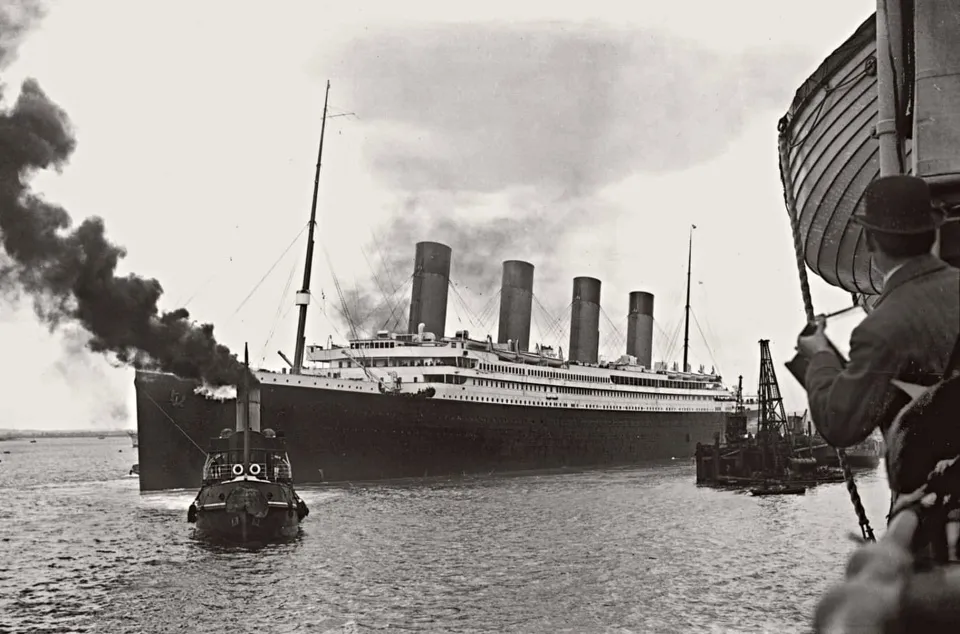
Titanic departing Southampton on April 10, 1921.
Passenger and Crew Totals:
- 1,316 Civilian Passengers
- 816 Civilian Deaths
- 909 Crew
- 697 Crew Deaths
- 67.19% Overall Death Rate
- 62.01% Passenger Death Rate
- 74.70% Crew Death Rate
Deaths by Passenger Class:
- 1st Class: 123 Deaths, 201 Survivors - 38% Death Rate
- 2nd Class: 166 Deaths, 118 Survivors - 58% Death Rate
- 3rd Class: 527 Deaths, 181 Survivors - 74% Death Rate
Death Rates by Age Range:
- Unknown: 2/2 = 100%
- Under 1 year: 2/11 = 18.18%
- 1-3 years: 14/32 = 43.75%
- 4-11 years: 34/63 = 53.97%
- 12-16 years: 30/47 = 63.83%
- 17-24 years: 251/379 = 66.23%
- 25-34 years: 226/262 = 62.26%
- 35-44 years: 138/219 = 63.01%
- 45-54 years: 66/125 = 52.80%
- 55-70 years: 49/72 = 68.06%
- more than 71 years: 4/4 = 100%
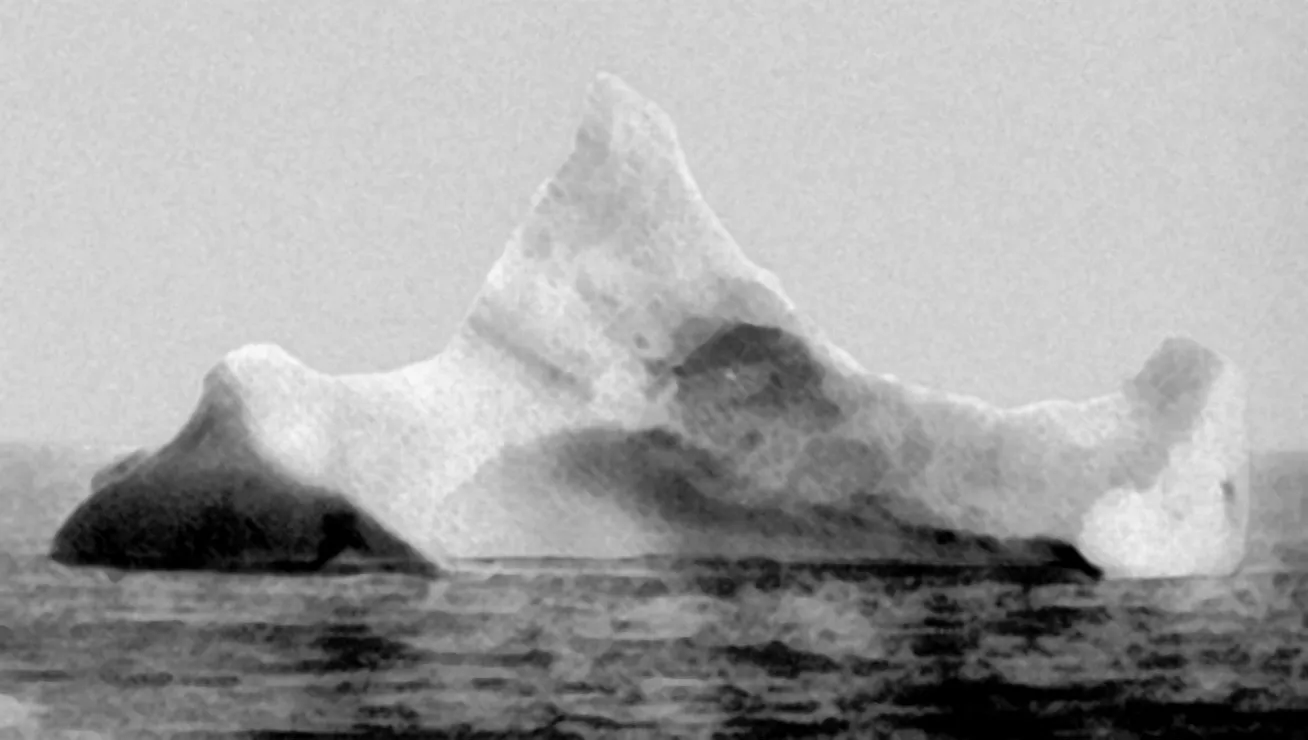
This is believed to be the iceberg the Titanic struck.
Passenger Deaths: Men vs Women vs Children:
The survival rate for men was much lower, as women and children were given priority when filling the lifeboats.
- Men: 1,337 dead, 323 survivors = 80.6% death rate
- Women: 107 dead, 331 survivors = 24.4% death rate
- Children: 51 dead, 58 survivors = 46.8% death rate
Deadliest Job on the Titanic (by Crew Position):
- Officer: 4/8 = 50% death rate (including Captain Edward Smith)
- Deck Crew: 39/58 = 67.24 death rate
- Engineering: 72/320 = 22.50% death rate
- Victuals: 94/431 = 21.81% death rate
- A La Carte Restaurant: 3/69 = 4.35% death rate
- Postal: 0/5 = 0% death rate
- Guarantee: 0/10 = 0% death rate
- Orchestra: 0/8 = 0% death rate
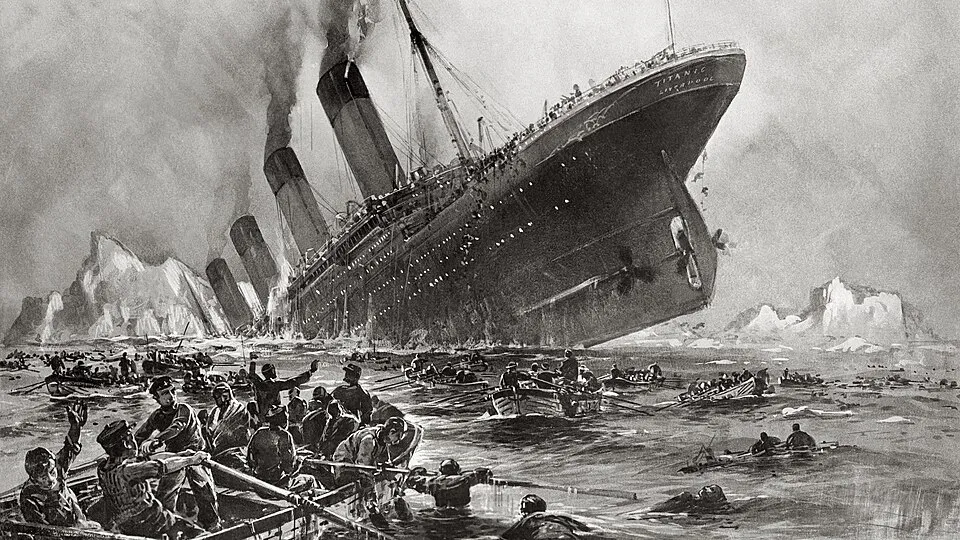
The painting Titanic Sinking (German: Untergang der Titanic), by artist Willy Stöwer, 1912
Timeline
Total Deaths
Because the Titanic disaster unfolded in such a short amount of time, the events shown on the timeline all took place within a few hours. Due to this compressed timeline and significant uncertainty as to who died when and from what cause, all deaths have been compiled into two timeline entries for the sake of simplicity. In reality, it is likely that at least a few deaths occurred before the ship had fully sunk beneath the waves.
0 deaths
Titanic Leaves Port in Southampton
0 deaths
Titanic Receives Ice Warnings
At 13:42 (01:42pm), Greek steamer Athenai reports "passing icebergs and large quantities of field ice today in 41° 51' N, 49° 52' W. Wish you and Titanic all success". Titanic received seven ice warnings in total but continues onward, as icebergs were considered a minor hazard and the ship was believed functionally unsinkable.
0 deaths
Iceberg Spotted, Turn Ordered
At 23:35 (11.35pm), lookout Frederick Fleet spots an iceberg, likely at the same time as it is seen at the bridge. Due to calm waters and low visibility, the iceberg is only between 450-900m away when first spotted, leaving the ship little time to maneuver.
0 deaths
Titanic Hits Iceberg
Despite efforts to turn, Titanic sideswipes the iceberg at 23:40 (11:40pm) and grinds alongside it for approximately six seconds. The exact form and degree of damage incurred by the initial impact is still a subject of debate among experts, but all agree that the Titanic incurs longitudinal damage that leaves 5-6 of the ship's watertight compartments taking on water.
0 deaths
Shipbuilder Determines the Titanic will Founder
At 23:45 (11:45pm), passenger Thomas Andrews, one of Titanic's main architects, observes that if indeed 5 (eventually 6) of the watertight compartments were breached and flooding, the ship would founder. He accurately estimates it would take around an hour and a half for the ship to sink. Captain Smith orders the lifeboats uncovered and the passengers mustered at 00:05 (12:05am).
0 deaths
Distress Signal Sent from Titanic
At 00:15 (12:15am) on April 15, Captain Smith orders the sending of a distress signal. Both CQD (Come Quick, Distress!) and the much newer SOS (Save Our Souls) distress signals are sent.
0 deaths
Captain Smith releases crew - "Every man for himself"
At 02:00 (2:00am), having carried out a final tour of the ship, Captain Smith releases the crew and radio operators from their duties, telling them to take their chances at survival. He famously says "Now it's every man for himself".
1.5K deaths
Titanic sinks beneath the Atlantic
At 02:20 (2:20am), the ship splits in two between the third and the fourth funnel, which sends the bow plunging toward the ocean bed at nearly 30mph. The stern levels out before tilting upward again and sinking, still full of air. The increasing water pressure causes the stern to implode as it descends to the ocean floor.
1 deaths
Carpathia Arrives to Rescue Survivors
At 04:10 (4:10am), the RMS Carpathia arrives at the location of Titanic's distress signal and immediately begins rescuing the lifeboats in the area. Only one person, a crewmember, dies after being pulled from the water.
A fairly detailed minute-by-minute account of the sinking of the Titanic has been reconstructed over the decades, largely via survivor accounts and events that have a specific timestamp, such as the ship’s distress call. That said, even a best-estimate recreation may deviate at least slightly from actual events, though it would be quite difficult to prove in this instance.
Map
The Titanic was owned by the White Star Line, a shipping company that specialized in travel between the United Kingdom and the United States. As a result, the majority of the ship’s passengers and crew hailed from one of those two countries. All but a handful of the remaining passengers and crew hailed from various European countries.
Note: At the time of the Titanic’s sinking, Austria and Hungary were merged into a single country, Austria-Hungary, which lost 49 citizens to the accident. These 49 deaths have been arbitrarily divided between Austria (25) and Hungary (24) for the purpose of mapping the data.
Death Totals by Country
Deaths
1
5
10
20
50
100
200
300
Categorization of Deaths (How)
Cause of Death
Anecdotal evidence and eyewitness accounts indicate that most deaths occurred not in the wreckage, but while floating in the water after the ship went down.
The water temperature at the time of the event was approximately 28 ℉ (−2 ℃), a temperature at which hypothermia would set in within approximately 20 minutes (and often sooner) amd often leading to death within an hour. The first ship to arrive on the scene and begin rescuing survivors, the passenger liner Carpathia, arrived roughly two hours after the Titanic sank. By then, most individuals floating in the water instead of in lifeboats had already succumbed to hypothermia.
Beyond hypothermia, very little evidence exists that can help determine what any given individual died from or when. Additional possible causes include drowning, crushing (if trapped inside the structure of the ship as it sank), other physical injury sustained during the sinking and/or evacuation, and suicide.
Categorization of Deaths (Who)
Who Died
Group | Deaths↓ |
|---|---|
| Men | 1,337 |
| Women | 107 |
| Children | 51 |
Show more
Survival rates for women and children were much higher than the rates for men, as the ship's crew attempted to follow the "women and children first" directive when populating the lifeboats. However, it is estimated that the average lifeboat launched at only 60% capacity, so significantly more people of all genders could have been saved if the evacuation had gone more smoothly.
Although no documentation exists regarding the number of pets aboard the Titanic, some reports indicate that at least three pets survived the event.
Men
Just over 75% of the Titanic's passengers (1,658 of 2,205 total) were men. Men also made up a full 89.4% of the casulaties, due to the policy of prioritizing women and children when loading the lifeboats.
Women and Children
Women made up 19.9% (438) of the Titanic's passengers and 7% of its casualties. Chlidren, meanwhile, made up 4.9% (107) of total passengers and 3.4% (51) of the casualties.
How Does This Compare
Similar Events Data
Rank | Event | Deaths↓ | Dates | Category |
|---|---|---|---|---|
| 1 | 9/11 Terrorist Attacks | 2,996 | Sept. 11, 2001 | Accidents and Attacks |
| 2 | Titanic | 1,495 | 1921-1921 | Accidents and Attacks |
| 3 | Sinking of the Lusitania | 1,197 | May 7, 1915 | Accidents and Attacks |
| 4 | Tenerife Airport Disaster | 583 | March 27, 1977 | Accidents and Attacks |
| 5 | Hindenburg Disaster | 36 | May 7, 1937 | Accidents and Attacks |
| 6 | Sinking of the HMHS Britannic | 30 | Nov. 21, 1916 | Accidents and Attacks |
Show more
The deadliest sinking of all time occurred on Jan. 30, 1945, when a Russian submarine sank the German ship MV Wilhelm Gustloff, which had been attempting to evacuate Nazi forces and civilians from East Prussia in the waning days of WWII. An estimated 9,000 passengers were killed.
Although the sinking of the Titanic is easily the best-known maritime disaster in the world—no doubt thanks in part to the surrounding details, such as the ship being purportedly “unsinkable”, the warnings that went overlooked, and the glamour of the ship being a luxury liner on its maiden voyage—other sinkings have actually resulted in even greater loss of life.
For example, the 1987 collision between the overloaded passenger ferry MV Doña Paz and the oil tanker MT Vector cost an estimated 4,386 lives. And in 1945, a Russian submarine sank the German ship MV Wilhelm Gustloff as it was carrying an estimated 10,000+ passengers, mostly German soldiers. 9,000 passengers perished, making the event the deadliest maritime sinking of all time.
Similar Events
1,197
0.8x smaller
Sinking of the Lusitania
One of several ships to carry its historic name, the RMS Lusitania was a British ocean liner that was in its day one of the largest and fastest passenger ships in the world. It was torpedoed by a German submarine in 1915 (during World War I). Unlike the Titanic, which took hours to sink, the Lusitania sank in less than 20 minutes. Only 763 of her 1,960 passengers survived.
4,386
2.93x larger
MV Doña Paz / MT Vector collision
On December 20, 1987, the passenger ferry MV Doña Paz collided with the oil tanker MT Vector, causing both ships to sink. The tanker had been operating without a proper license. Total death counts are murky, as the Doña Paz's passneger manifest listed only 1,583 passengers and 58 crew members, but the ship also carried at least 2,000 unofficial passengers who had purchased illegal tickets.
Methodology
Note: For greater detail on the origin of specific data points, see ‘Sources’ section below.
Challenges in Titanic Data
Significant uncertainty exists regarding many aspects of the Titanic disaster. For example, timeline information is scratchy and largely based on testimony, as most physical evidence remains at the bottom of the Atlantic.
The precise number of passengers, deaths, and survivors is also unclear. Estimates of total deaths range from 1,491 to 1,635. The estimate used for the majority of this page, 1,496, was made by the British board of Trade Inquiry and is corroborated by the records of recovered bodies, crew logs, passenger lists, and other data.
Even more unclear are the causes of each death. With the exception of the few hundred bodies recovered from the waters after the fact, no reliable data exists regarding the various causes of death and their victims.
It can be reliably estimated that a majority of the deaths occurred from hypothermia, due to the ship having many lifejackets but few lifeboats, meaning that people mostly survived the sinking but succumbed to hypothermia while floating in the water afterward. It is also safe to assume some individuals did drown, particularly those trapped in internal compartments in the stern in 3rd class. Others likely died from crushing as air pockets imploded as the ship sunk. There also exist a few anecdotal cases of specific people being crushed by the funnels.
Unfortunately, while acknowledging the existence of these possible causes of death is fairly simple, it is functionally impossible to determine how many passengers and crew may have died from any of these causes. Any estimates are based upon speculation, conjecture, and generous extrapolation of available eyewitness accounts.
Finally, there exists significant uncertainty regarding how much of the blame for the ship’s sinking lies with the initial iceberg impact and how much was in fact due to flaws in the ship’s design and/or construction.
Sources
Archival
Books
- Tad Fitch, J. Kent Layton and Bill Wormstedt, On a Sea of Glass: The Life & Loss of the RMS Titanic (Amberley Publishing, 2015)
- Tim Maltin, Titanic: First Accounts (Penguin Classics, 2012)
- Walter Lord, A Night to Remember (R&W Holt, 1955)
- Charles Haas & John Eaton, Titanic: Triumph and Tragedy (WW Norton, 1995)
- Robert D. Ballard, The Discovery of the Titanic (New York: Warner Books, 1987)
Online
- The Long, Strange Trip of the Titanic Victims Whose Remains Surfaced Hundreds of Miles Away, Weeks After the Ship Sank - Smithsonian Mag
- The Titanic Sinking: 1912: History - College of Coastal Georgia
- Titanic Victims Bodies - Encyclopedia Titanica
- 7 of the World's Deadliest Shipwrecks - Encyclopedia Britannica
- Crew of the Titanic - Wiki
- Passengers of the Titanic - Wiki
- Titanic Victims - Titanic Facts
- List of Accidents and Disasters by Death Toll - Wiki
- How Cold Was the Water When the Titanic Sank? - Encyclopedia Titanica
- Sinking of the Titanic - Wiki
- Iceberg that Sank the Titanic - Wiki