Same-Sex Marriage by State 2026
Married Couples
State | Legal Protection↓ | Same-Sex Marriage Ban Status | Date Same-Sex Marriage Legalized | Additional Details | |
|---|---|---|---|---|---|
 | California | State and Federal | Has comprehensive civil union or domestic partnership law. | June 28, 2013 | California law provides domestic partnerships that grant nearly all state-level spousal rights, including tax, inheritance, medical decision-making, and benefits, creating a legal recognition framework alongside marriage. |
 | Colorado | State and Federal | Has comprehensive civil union or domestic partnership law. | October 7, 2014 | Colorado repealed the statutory definition limiting marriage to one man and one woman, leaving marriage governed by the U.S. Supreme Court ruling in Obergefell v. Hodges (2015), which guarantees same-sex marriage rights nationwide. |
 | Florida | State and Federal | Banned by constitution and statute | January 6, 2015 | |
 | Illinois | State and Federal | Has comprehensive civil union or domestic partnership law. | June 1, 2014 | Same-sex marriage has been fully legal in Illinois since 2014 under the Religious Freedom and Marriage Fairness Act, which converted civil unions into full marriage equality and grants same-sex couples full state-level marriage rights. Illinois also previously allowed civil unions (since 2011), which provided many of the same legal protections before full marriage recognition. |
 | Maine | State and Federal | Has comprehensive civil union or domestic partnership law. | December 29, 2012 | Same-sex marriage has been fully legal in Maine since 2012 after voters approved Question 1, restoring marriage equality and allowing same-sex couples to legally marry under state law. Maine previously passed and then repealed a 2009 marriage equality law before permanent legalization was established through the 2012 ballot initiative. |
 | Maryland | State and Federal | Has comprehensive civil union or domestic partnership law. | January 1, 2013 | Same-sex marriage has been legal in Maryland since 2013 under the Civil Marriage Protection Act, which grants same-sex couples full civil marriage rights at the state level. The law was supported through both legislative approval and voter referendum, confirming statewide legal and public endorsement of marriage equality. |
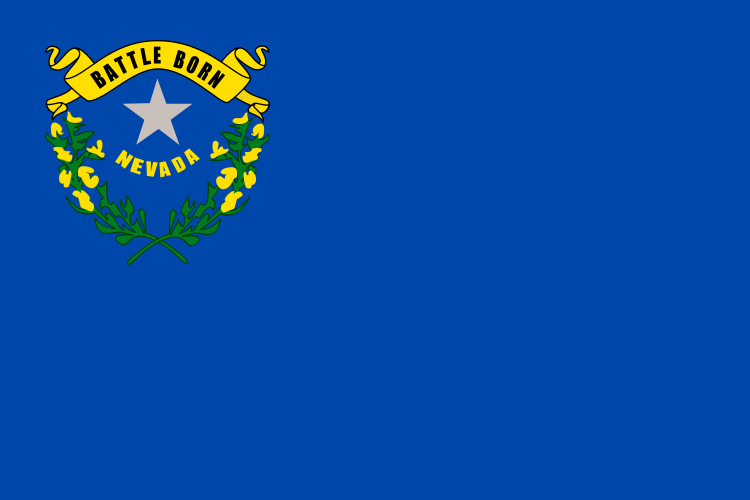 | Nevada | State and Federal | Has comprehensive civil union or domestic partnership law. | October 9, 2014 | Same-sex marriage has been legal in Nevada since 2014 at the state level, granting same-sex couples the right to marry following legal and public shifts in support confirmed by court interpretation and state policy changes. State constitutional barriers were effectively invalidated through federal equal protection standards, and Nevada subsequently aligned its laws to permit marriage equality. |
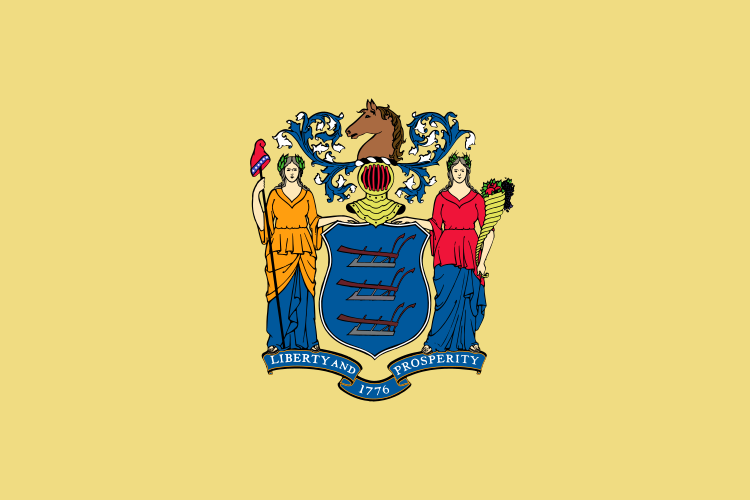 | New Jersey | State and Federal | Has comprehensive civil union or domestic partnership law. | October 21, 2013 | Same-sex marriage has been legal in New Jersey since 2013 following a court ruling that invalidated the state's restriction on marriage equality and led to issuance of marriage licenses to same-sex couples. The state subsequently maintained marriage equality at the state level, despite ongoing legislative attempts to define marriage as between one man and one woman. |
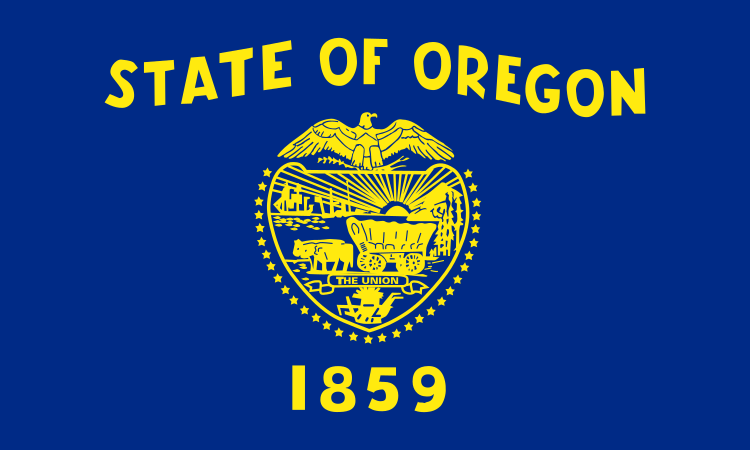 | Oregon | State and Federal | Has comprehensive civil union or domestic partnership law. | May 19, 2014 | Same-sex marriage has been legal in Oregon since 2014 following a federal court ruling that struck down the state's constitutional ban as violating due process and equal protection rights. Oregon had already recognized same-sex marriages performed in other states since 2013, and marriage equality took immediate effect statewide after the ruling. |
 | Alabama | Federal | Banned by constitution and statute | February 9, 2015 | |
 | Alaska | Federal | Banned by constitution and statute | October 17, 2014 | |
 | Arizona | Federal | Banned by constitution and statute | October 17, 2014 | |
 | Arkansas | Federal | Banned by constitution and statute | June 26, 2015 | |
 | Connecticut | Federal | Not banned | November 12, 2008 | |
 | Delaware | Federal | Not banned | July 1, 2013 | |
 | Georgia | Federal | Banned by constitution and statute | June 26, 2015 | |
 | Hawaii | Federal | Has comprehensive civil union or domestic partnership law. | December 2, 2013 | Same-sex marriage has been fully legal in Hawaii since 2013 under the Hawaii Marriage Equality Act, which grants same-sex couples full state-level marriage rights. In addition, Hawaii recognizes civil unions that provide the same legal rights, benefits, and responsibilities as marriage under state law. |
 | Idaho | Federal | Banned by constitution and statute | October 13, 2014 | |
 | Indiana | Federal | Banned by statute | October 6, 2014 | |
 | Iowa | Federal | Banned by statute but protected by court order | April 24, 2009 | |
 | Kansas | Federal | Banned by constitution and statute | November 12, 2014 | Allows religious exemptions: Faith-based organizations may deny services to married same-sex couples. |
 | Kentucky | Federal | Banned by constitution and statute | June 26, 2015 | |
 | Louisiana | Federal | Banned by constitution and statute | June 26, 2015 | |
 | Massachusetts | Federal | Not banned | May 17, 2014 | |
 | Michigan | Federal | Banned by constitution and statute | June 26, 2015 | |
 | Minnesota | Federal | Not banned | August 1, 2013 | |
 | Mississippi | Federal | Banned by constitution and statute | June 26, 2015 | Allows religious exemptions: A 2016 law (H.B. 1523) permitted state officials to decline to marry couples of whose marriage they disapprove.It was overturned by a federal court and is stayed from enforcement as of 2023. |
 | Missouri | Federal | Banned by constitution and statute | June 26, 2015 | |
 | Montana | Federal | Banned by constitution and statute | November 19, 2014 | |
 | Nebraska | Federal | Banned by constitution | June 26, 2015 | |
 | New Hampshire | Federal | Not banned | January 1, 2010 | |
 | New Mexico | Federal | Not banned | December 19, 2013 | |
 | New York | Federal | Not banned | July 24, 2011 | |
 | North Carolina | Federal | Banned by constitution and statute | October 10, 2014 | Allows religious exemptions: State officials to decline to marry couples of whose marriage they disapprove. |
 | North Dakota | Federal | Banned by constitution and statute | June 26, 2015 | |
 | Ohio | Federal | Banned by constitution and statute | June 26, 2015 | |
 | Oklahoma | Federal | Banned by constitution and statute | October 6, 2014 | |
 | Pennsylvania | Federal | Banned by statute | May 20, 2014 | |
 | Rhode Island | Federal | Not banned | August 1, 2013 | |
 | South Carolina | Federal | Banned by constitution and statute | November 20, 2014 | |
 | South Dakota | Federal | Banned by constitution and statute | June 26, 2015 | |
 | Tennessee | Federal | Banned by constitution and statute | June 26, 2015 | |
 | Texas | Federal | Banned by constitution and statute | June 26, 2015 | |
 | Utah | Federal | Banned by constitution and statute | October 6, 2014 | |
 | Vermont | Federal | Not banned | September 1, 2009 | |
 | Virginia | Federal | Banned by constitution | October 6, 2014 | |
 | Washington | Federal | Not banned | December 9, 2012 | |
 | West Virginia | Federal | Banned by statute | October 9, 2014 | |
 | Wisconsin | Federal | Banned by constitution and statute | October 6, 2014 | |
 | Wyoming | Federal | Banned by statute | October 21, 2014 | |
 | District of Columbia | District and Federal | Has comprehensive civil union or domestic partnership law. | March 3, 2010 | Same-sex marriage has been legal in the District of Columbia since 2010, following the passage of the Religious Freedom and Civil Marriage Equality Amendment Act, which allowed same-sex couples to marry and receive full marriage rights at the district level. In addition, D.C. had already recognized domestic partnerships and out-of-jurisdiction same-sex marriages with many marriage-equivalent rights, reinforcing a broader legal framework for relationship recognition. |
- The 2015 Federal Supreme Court case Obergefell v. Hodges established marriage equality nationwide. This ruling superceded state-level laws, thereby legalizing same-sex marriage across the entire United States.
- A majority of states still have laws—currently unenforceable due to Obergefell—which use either a legal statute, a constitutional amendment, or both to ban marriage between same-sex couples.
- Just over 25% of states have specifically legalized same-sex marriages through a comprehensive civil union or domenstic partnership law.
- A small number of states have established targeted religious exemptions, such as allowing faith-based organizations to deny services to same-sex couples based upon the organization’s religious beliefs.
- If Obergefell were overturned, these state-level bans, legalizations, and exemptions would enter into effect.
Same-Sex Marriage Legal Status in the United States
Same-sex marriage is legal nationwide in the United States following the 2015 Supreme Court decision in Obergefell v. Hodges, which guarantees the right to marry regardless of gender in all states.
While all states must recognize and allow same-sex marriages, some still have constitutional or statutory bans on the books. These laws are no longer enforceable but remain part of state legal codes unless formally repealed.
States with No Same-Sex Marriage Ban
Some states do not have any constitutional or statutory bans on same-sex marriage in their legal codes. In these states, marriage laws are fully aligned with current federal protections.
States in this category include California, Connecticut, Delaware, District of Columbia, Hawaii, Illinois, Maine, Maryland, Massachusetts, Minnesota, Nevada, New Hampshire, New Jersey, New Mexico, New York, Rhode Island, Vermont, and Washington.
States with Same-Sex Marriage Bans (Unenforceable)
Many states still have same-sex marriage bans written into their constitutions or statutes, even though these laws cannot be enforced under federal law. These bans remain in place unless formally repealed by state legislatures or voters.
States in this category include Iowa, Colorado, Indiana, Pennsylvania, West Virginia, Wyoming, Nebraska, Oregon, Virginia, Alabama, Alaska, Arizona, Arkansas, Florida, Georgia, Idaho, Kansas, Kentucky, Louisiana, Michigan, Mississippi, Missouri, Montana, North Carolina, North Dakota, Ohio, Oklahoma, South Carolina, South Dakota, Tennessee, Texas, Utah, and Wisconsin.
Same-Sex Marriage Rates by State
Same-sex marriages make up a small but measurable share of total marriages across the United States, with notable variation by state. In most states, same-sex marriages account for roughly 1% to 2% of all married couples.
Some of the highest shares are found in the District of Columbia (5.96%), Delaware (2.34%), Vermont (2.11%), and Nevada (1.98%). On the lower end, states such as North Dakota (0.26%), South Dakota (0.59%), and Iowa (0.64%) have smaller shares, reflecting regional and demographic differences across the country.
Same-Sex Cohabiting Households by State
Same-sex cohabiting households provide another view of how same-sex couples are distributed across the country, including those who are not married. These households are present in every state but tend to be more concentrated in larger and more urban populations.
States with the highest totals include California, Texas, Florida, and New York, each with tens of thousands of same-sex cohabiting households. Smaller states such as Wyoming, South Dakota, and Alaska report much lower totals, reflecting overall population size rather than differences in legality or acceptance.