Indiana's minimum wage of $7.25 in 2026 is below average in the United States, and it is the same as than the base federal minimum wage of $7.25 still used in 20 states.
 Federal
 Indiana
Assuming a standard 40-hour work week, the weekly minimum wage in Indiana is $290. For full-time employees working 52 weeks per year, the annual minimum wage in Indiana is $15.1K.
Based on $7.25/hr minimum
Based on $7.25/hr minimum
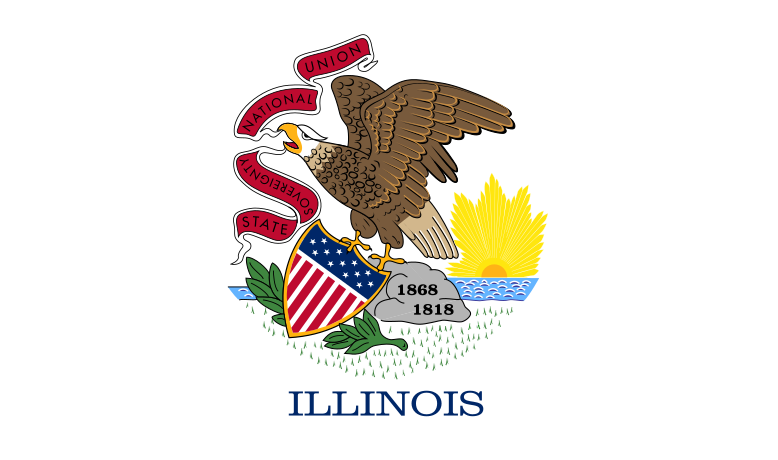
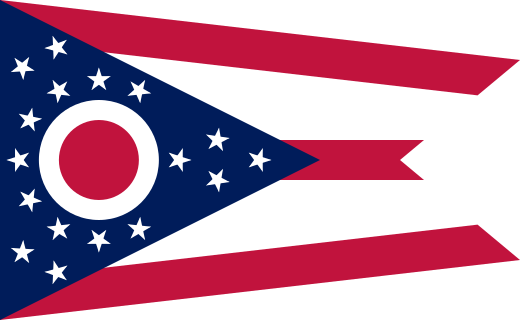
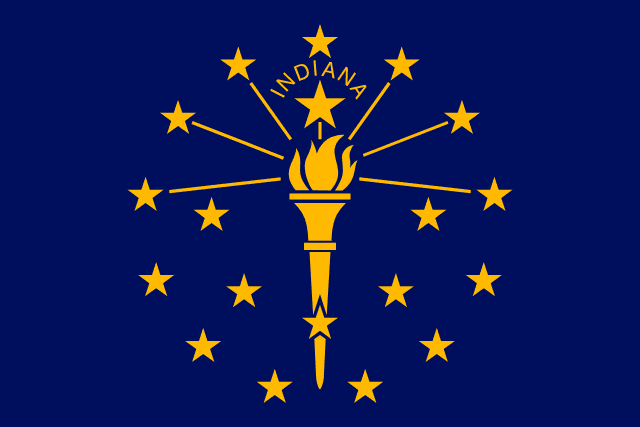
The minimum wage rate of Indiana and its neighboring states ranges from $7.25 to $15, with an average of $10.85. Indiana, at $7.25, has the lowest hourly minimum wage within this group of states. Illinois ($15), Michigan ($13.73), and Ohio ($11) all have higher hourly rates than Indiana. Kentucky shares the same $7.25 hourly rate as Indiana.
 Indiana
While the general minimum wage is $7.25 per hour in Indiana, there are several exceptions where workers may legally receive less than this amount:
Employers may pay tipped workers a reduced cash wage of $2.13/hr, provided that tips + cash wage together total at least $7.25/hr. Employer must make up any shortfall. Tip credit of up to $5.12/hr.
Employers may pay workers under age 20 a reduced training wage for the first 90 consecutive calendar days of initial employment. Employer cannot use this wage to displace existing employees.
Full-time high school or college students working part-time (≤20 hrs/week) in certain roles such as work-study programs may be paid 85% of the minimum wage.
Employees engaged in agriculture or horticulture are explicitly exempt from Indiana's state minimum wage law under Indiana Code.
Students who provide services for a school, college, or university in which they are enrolled and regularly attend classes are exempt.
Student nurses working at hospitals or nurse training schools while enrolled in an accredited nursing program are exempt from Indiana minimum wage and overtime laws.
Apprentices performing services for licensed funeral directors and embalmers as part of the apprenticeship requirements necessary to obtain their own license are exempt.
Individuals who have completed a four-year course in medical school and are working as interns or resident physicians at any accredited hospital are exempt.
Employees with disabilities working for nonprofit organizations are exempt from Indiana minimum wage and overtime requirements.
Businesses with annual revenue under $500,000 not involved in interstate commerce may be exempt from state wage law. Most such employers are still subject to FLSA if covered.
Salaried workers meeting duties and salary-level tests (≥$1,128/week as of Jan 1, 2025) are exempt from minimum wage and overtime per FLSA.
Sales employees whose primary duty is making sales away from the employer's place of business are exempt from minimum wage and overtime.
Indiana's cost of living index for 2025 is 91, which places it as the 42nd most expensive state to live in the United States.
 National
100
Indiana91
Assuming a standard 40-hour work week, the real wage in Indiana, adjusted for the state’s cost of living index of 91, is approximately $7.97 per hour. This means that while the nominal minimum wage is $7.25 per hour, the purchasing power of those earnings is higher due to Indiana's lower cost of living expenses. For full-time employees, the real weekly earnings amount to roughly $318.68, translating to an annual purchasing power of $16,571.43 when working 52 weeks per year.
Adjusted
Adjusted
Adjusted
90K
95K
100K
105K
110K
115K
120K
According to the most recent data, the median household income in the United States has seen a significant increase in 2023.
Indiana’s minimum wage is established under state law at $7.25 per hour and aligns with the federal minimum wage set by the Fair Labor Standards Act (FLSA). The state does not provide for automatic increases, and any changes to the minimum wage occur only through legislative action.